microwave repair
Microwave not heating or door stuck shut? Honest microwave repair costs, safe checks to try, and when to call a technician instead of buying new.
Need microwave repair? Call now for same-day service.
Call +1 (888) 206-0056Your microwave died in the middle of dinner prep. Now what. This microwave repair guide walks through the most common failures. You will learn what is safe to check yourself. You will learn what needs a pro. And you will learn when buying new is the smarter move. This page covers countertop, over the range, and built in models. It also covers what people call microwave oven repair, which is the same service under a different name.
Microwave repair: the most common problems
Microwaves fail in predictable ways. Most problems come from a small set of parts. Read the symptom that matches yours to see the likely cause and whether it is worth fixing.
Not heating
The light is on, the turntable spins, but the food stays cold. This is the top microwave complaint. The likely cause is a failed magnetron, a blown high voltage diode, or a failed capacitor. A bad door switch can cause it too. The heating parts live behind the metal cover and carry dangerous voltage. This is never a DIY repair. If your unit is a cheap countertop model, replacement usually wins. On an over the range or built in unit, magnetron replacement is often worth it.
No power at all
The display is dark and nothing happens. Check the outlet first. Plug in a toaster to confirm power. Microwaves draw a lot of current, so they trip breakers more than most small appliances. Next check the door. A microwave will not start unless the door latches fully. If power and the door are fine, an internal fuse has blown. Fuses blow for a reason, usually a failing door switch or a shorted part. Replacing the fuse without finding the cause just blows the next one.
Sparking or arcing inside
Stop using the microwave and unplug it. Sparking usually comes from a burnt waveguide cover. That is the small cardboard or mica plate on the inside wall. Food splatter burns it over time and it starts to arc. A tech can replace the cover cheaply. Sparking can also come from damage to the cavity wall or a bit of metal left inside. If the metal wall itself is burnt or rusted through, the unit cannot be saved. Never run a sparking microwave while you decide. Unplug it and leave it off.
Door will not close or latch
The door hooks take a beating. Every slam wears them a little more. When the latch no longer clicks, the safety switches do not engage. The microwave then refuses to start. That refusal is a safety feature, not a new problem. Latch and hook kits are cheap. A tech can replace them in under an hour. A cracked door frame is different. The door shields you from microwave energy. A damaged door or frame means the unit must be replaced. Do not tape it, glue it, or force it.
Turntable not turning
Food heats unevenly when the turntable stops. First check that the glass tray sits correctly on the roller ring. A tray knocked off center will jam. If the tray is seated right, the turntable motor has likely failed. This is one of the cheapest microwave fixes. Motors cost little and swap out fast. The turntable motor is one of the few internal repairs an owner can do safely. It sits far from the high voltage parts. Unplug the unit first no matter what.
Loud humming
Microwaves hum while they run. A loud new buzz is different. It often points to a failing magnetron or a bad high voltage diode. A loud hum that comes with no heat almost always means the magnetron is dying. Another cause is a loose transformer or a cooling fan hitting debris. If the hum started suddenly and food still heats, keep an ear on it. If the hum comes with no heat or a burning smell, unplug the unit and call a tech.
Burning smell
Unplug it. A burning smell from a microwave deserves respect. It can come from food baked onto the waveguide cover, which is a cheap fix. It can also come from a failing magnetron or melting wiring, which is not. Do not keep using the microwave to see if the smell goes away. Let a tech open it and find the source. Burnt wiring inside a microwave is a fire risk you cannot see from outside.
When to call a microwave oven repair technician
Searching for a microwave oven repair technician usually means one thing. You want a pro who does this daily, not a handyman guessing. Here is what to expect and what to ask.
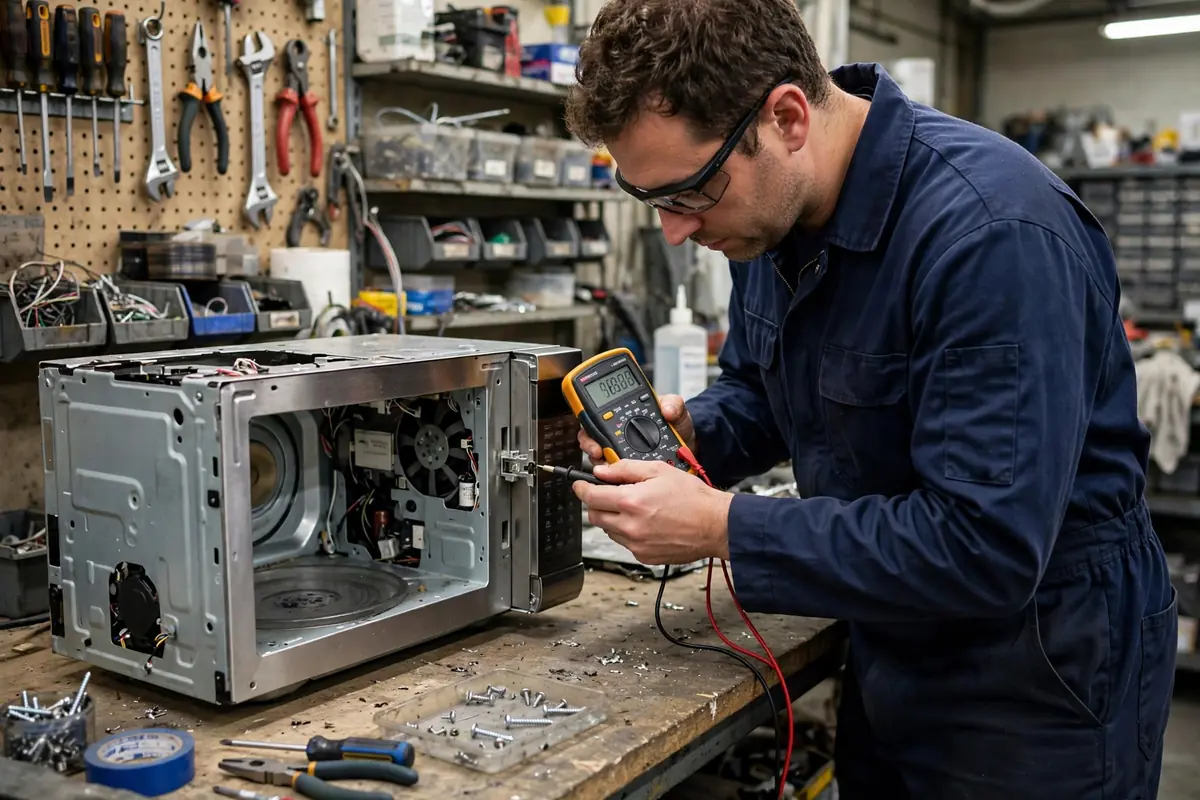
A real technician tests before replacing. Microwaves have three door interlock switches. A good tech checks each one with a meter before ordering parts. Guessing at the magnetron without testing the switches wastes your money. Ask the tech to show you the failed part and explain the test. That is a fair request on any repair.
Safety is the big reason to hire a pro for microwaves. The high voltage capacitor inside can hold a lethal charge even when the unit is unplugged. Trained technicians discharge it safely before touching anything. This is the one appliance where DIY repair behind the cover is genuinely dangerous. Cleaning, turntable motors, and door handles are fine. Everything else belongs to a technician.
Cost matters too. Ask for a flat rate quote before work starts. Ask whether the diagnostic fee is credited toward the repair. A reputable microwave repair service gives both answers upfront. If a shop will not quote a flat rate, call the next one.
Checks to try before you call
These cost nothing and fix a surprising share of microwave problems. Stay outside the cover. Never remove it.
- Confirm the power level is set to high, not a low setting.
- Test the outlet with another appliance. Check the breaker.
- Close the door firmly and listen for the latch click.
- Reseat the glass tray on the roller ring.
- Clean the waveguide cover gently. Burnt food splatter causes arcing.
- Check that the child lock is not engaged. It confuses many owners.
- Note the exact symptom: no power, no heat, sparking, or noise.
Typical repair costs
Microwave fixes are usually cheap, which is why the repair or replace math matters so much. Prices below are typical ranges charged by shops across the US. Your quote depends on the model type and your market. Compare it against a new unit before you approve.
- Diagnostic visit: $60 to $130, often credited toward the repair
- Door switch or latch kit: $100 to $180
- Internal fuse: $80 to $150
- Turntable motor: $80 to $160
- Waveguide cover replacement: $90 to $160
- High voltage diode or capacitor: $120 to $220
- Magnetron replacement: $150 to $300
- Control board: $150 to $300
If your wall oven is the problem, our oven repair guide covers that separately. To browse everything we fix, start at our home page.
Repair or replace: the honest math
Microwaves are the one appliance where replacement often wins. Countertop models cost $80 to $150 new. A $150 repair on a $100 microwave makes no sense. Use the 50 percent rule. If the repair costs more than half of a comparable new unit, buy new.
The math flips for over the range and built in models. Those cost $400 to $1,000 installed. A $200 magnetron in a two year old over the range unit is clearly worth it. Built ins also match your cabinetry, which makes replacement a bigger project than the price tag suggests.
Age decides the close calls. Under five years, repair most single part failures on mid range and premium models. Over eight years, or facing a second repair, replace. Old microwaves also lose efficiency and door seal quality with age. A new unit heats faster and uses less power.
Get your microwave fixed today
Do not run a sparking or smoking microwave while you decide. Pick your city in areas we serve to book a technician visit. We serve Milwaukee, Sacramento, and Grand Rapids. Same day and next day slots are available. Door latches, switches, and turntable motors are carried on the truck, so most jobs finish in one visit. Describe the exact symptom when you book so the tech arrives with the right parts.
Frequently asked questions
Why is my microwave not heating?
A microwave that runs but does not heat usually has a failed magnetron or a blown high voltage diode. A failed door switch can do it too. Check the easy things first: confirm the power level is set to high and the timer actually started. If food comes out cold after a full cycle, the heating parts have failed. Those parts carry lethal voltage even when unplugged. This is a technician job, not a DIY fix.
Is it safe to repair a microwave myself?
Only for the simplest tasks. Cleaning, replacing a turntable motor, or swapping a door handle is fine. Anything behind the cover is not. The high voltage capacitor can hold a deadly charge even after the unit is unplugged. Magnetrons, diodes, and transformers must be tested and replaced by a trained technician. Never open the metal cover yourself.
Should I call a microwave oven repair technician or buy a new one?
It depends on the type. Countertop microwaves cost $80 to $150 new, so most repairs do not make sense. Over the range and built in microwaves cost $400 to $1,000, which makes repair the smarter call. Use the 50 percent rule. If the repair costs more than half of a comparable new unit, replace it.
What does microwave repair usually cost?
Most microwave fixes run $100 to $300. Door switches, fuses, and turntable motors sit at the low end. Magnetron replacement sits at the high end, around $150 to $300. A diagnostic visit usually costs $60 to $130, and many shops credit it toward the repair. Compare that quote against the price of a new unit before you approve.
Why is my microwave sparking inside?
Stop using it and unplug it. Sparking usually comes from a burnt waveguide cover or a bit of metal left on food. Damage to the cavity wall can do it too. A scorched waveguide cover is a cheap part a tech can replace. If the cavity wall itself is burnt through, the unit is done. Never run a sparking microwave. It can start a fire.
Why won't my microwave door close or latch?
The door hooks and latches take abuse every day and they wear out. A door that will not latch cannot trigger the safety switches, so the microwave will not start. That is by design. Latch kits are cheap and a tech can replace them fast. A cracked door frame is a bigger problem. Never use a microwave with a damaged door.
Broken appliance? We're one call away.
Same-day appliance repair across 37 cities. Upfront pricing, written warranty, and an honest repair-or-replace answer on every job.
Call +1 (888) 206-0056