freezer repair
Standalone freezer not freezing? Freezer repair for chest, upright, and garage freezers. Honest cost ranges, checks to try first, and repair vs replace help.
Need freezer repair? Call now for same-day service.
Call +1 (888) 206-0056A dying freezer can spoil hundreds of dollars of food overnight. This freezer repair guide covers standalone units only: chest freezers, upright freezers, and garage freezers. If the failing freezer belongs to a fridge combo unit, read our refrigerator repair guide instead. That page covers combo units and their shared cooling system.
Freezer repair: common problems by symptom
Standalone freezers are simpler than fridges. No water dispensers, no ice makers on most models, no damper systems. That makes diagnosis faster and repairs cheaper. Below are the failures behind most freezer repair calls.
Not cold enough
The freezer runs but food stays soft. Start with the thermostat setting. It should read 0 degrees, not 10 or 15. Next look at the coils. Dusty condenser coils are the top cause of weak cooling on chest freezers. They sit underneath or on the back and collect dust for years. Clean them with a coil brush or vacuum. A worn lid gasket is the other big one. Warm air sneaks in around a cracked seal and the freezer can never catch up. Test it with a dollar bill. Close the lid on the bill. If it slides out easily, the seal leaks.
Running constantly
A freezer that never cycles off is working too hard. After a big grocery load, give it 24 hours to catch up. In a hot garage, long run times are normal in summer. If it runs nonstop for more than a day, something is wrong. Dirty coils, a bad gasket, or low refrigerant all cause endless running. A thermostat that misreads temperature does too. Endless running wastes power and wears out the compressor. Get it checked before a small problem becomes a dead compressor.
Heavy frost buildup
Some frost on a manual defrost chest freezer is normal. A thick white crust everywhere is not. Frost means warm humid air is entering the cabinet. The usual entry point is the lid gasket. It cracks and flattens with age. Frequent long openings add frost too. Teach everyone to decide what they want before opening the lid. On auto defrost uprights, recurring frost points to a failed defrost heater, thermostat, or timer. One manual defrost buys time. If the frost returns within weeks, the defrost system needs repair.
Clicking but not starting
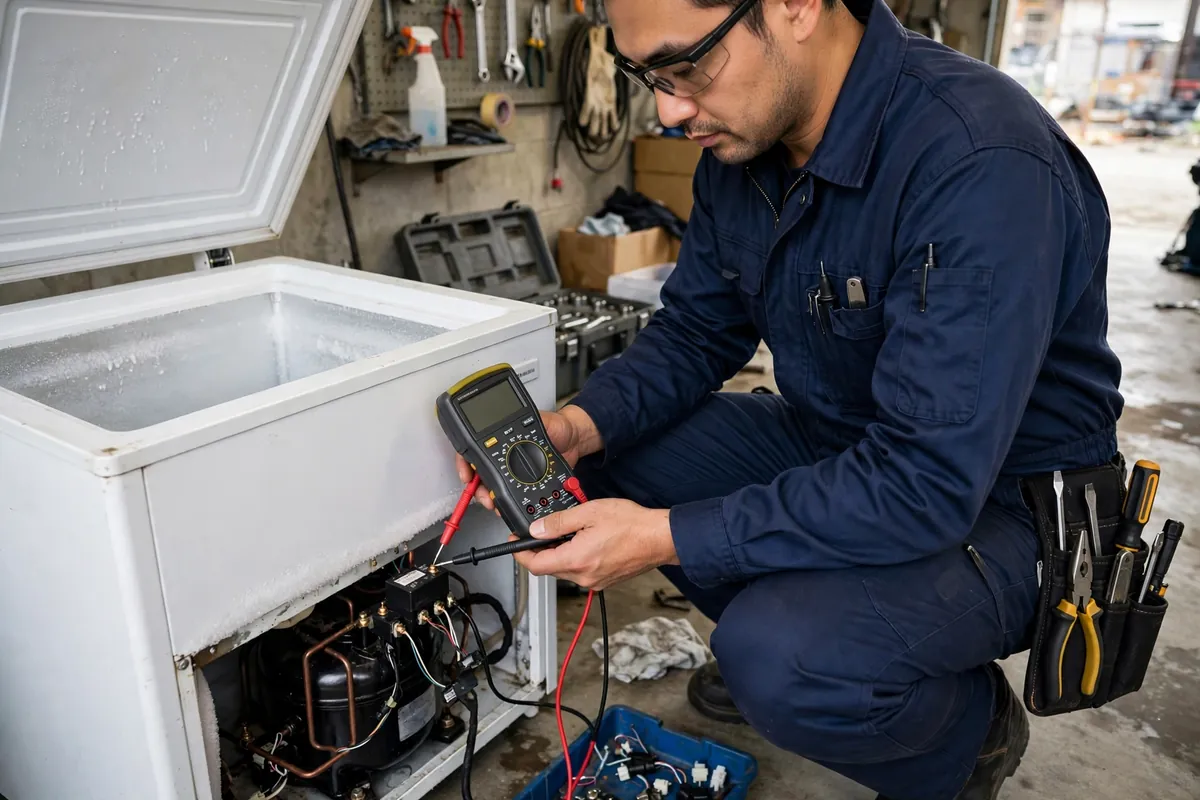
Clicking every few minutes is a classic sign of a failed start relay. The relay helps the compressor start. When it fails, the compressor tries, clicks, and gives up. This is one of the cheapest freezer fixes. A new relay often solves it in minutes. But the same click can come from a dying compressor. A tech tests the relay first with a meter. If the relay is good and the compressor still will not start, the compressor itself has failed. That changes the repair math completely.
Water pooling inside or under the unit
Water inside a chest freezer usually comes from a plugged drain. Chest freezers have a small drain plug at the bottom for defrosting. If it clogs, meltwater pools under the food. Clear it with warm water. Water under the unit is different. Check the drain pan and the drain tube for cracks. A cracked tube drips water onto the floor every cycle. Level matters too. A tilted freezer can send drain water the wrong way. Keep the unit level for proper drainage.
Won’t turn on at all
No lights, no hum, nothing. Check the outlet first. Plug in a lamp to confirm power. Freezers trip breakers more than people expect, especially in garages where the circuit is shared. Check the breaker and any GFCI outlet on the circuit. Garage GFCI outlets trip from moisture and kill the freezer silently. Many owners only discover it when food has already thawed. If power is fine and the unit is dead, the thermostat or control board has failed.
Chest freezers vs upright freezers: what changes
The repair changes with the style. Knowing which type you own helps you describe the problem and understand the quote.
Chest freezer repair
Chest freezers are the simplest and toughest freezers made. They have few moving parts and thick insulation. That insulation holds cold for days in a power outage. Repairs are usually cheap: start relays, thermostats, and gaskets. Their weakness is the lid. A heavy lid with a worn gasket or a broken hinge seal lets in warm air nonstop. Rust is the other enemy. A rusted interior or a cracked drain plug can end an old chest freezer. Because new chest freezers cost little, repairs over $300 deserve a hard look at replacement.
Upright freezer repair
Uprights trade toughness for convenience. Shelves, door bins, and auto defrost make life easier, but they add failure points. Auto defrost uprights can fail at the heater, thermostat, or timer, which brings the frost back every few weeks. Door gaskets see more abuse than chest lids and fail sooner. Fans also fail on uprights. If you hear no air movement inside, the evaporator fan may be dead. The chest freezer repair advice above covers parts both styles share. Uprights add one more system. Their defrost heater, thermostat, or timer needs checking whenever frost returns.
Garage freezers in cold climates
Garage freezers face a special problem. Standard freezers assume the room stays above freezing. In a cold garage, the compressor may rarely run. That sounds fine for a freezer, but the thermostat can misread and let temperatures swing. Food can partially thaw and refreeze, which ruins quality and safety. Garage ready models use a different thermostat design that handles swings from below freezing to over 100 degrees. If your manual says the unit is rated for garage use, you are fine. If not, a garage ready model is the safer buy.
Checks to try before you call
Do these in order. They cost nothing and solve a surprising share of freezer problems. Note what you find. It helps the tech.
- Confirm the thermostat is set to 0 degrees.
- Test the outlet with a lamp. Check the breaker and any GFCI on the circuit.
- Clean the condenser coils with a brush or vacuum.
- Test the lid or door gasket with a dollar bill.
- Make sure the unit is level. A tilted freezer drains wrong.
- Defrost thick frost fully, then watch how fast it returns.
- Move the unit away from heat sources like dryers and furnaces.
Typical repair costs
Prices below are typical ranges charged by shops across the US. A freezer repair service visit usually costs less than a fridge visit because the diagnosis is simpler. Your quote depends on the brand, the style, and your market. No one can price a repair without seeing the unit.
- Diagnostic visit: $60 to $130, often credited toward the repair
- Start relay: $120 to $250
- Thermostat: $120 to $250
- Lid or door gasket: $150 to $300
- Evaporator fan (uprights): $150 to $300
- Defrost heater or thermostat (uprights): $150 to $350
- Control board: $200 to $500
- Compressor or sealed system: $500 to $900, with premium uprights reaching $1,200 or more
The sealed system is the big jump. It needs special tools, a licensed tech, and often an ordered part. On a $250 chest freezer, sealed system work almost never makes sense.
Repair or replace: how to decide
Start with the 50 percent rule. If the repair costs more than half of a comparable new freezer, replace it. Chest freezers are cheap to buy new, which sets a low repair ceiling. A $150 relay in any working freezer is worth it. A $700 compressor job in a 10 year old chest freezer is not. Age sharpens the call. Under eight years, most single part repairs are worth doing. Over 12 years, or facing a second major repair, buy new.
Energy use tips close calls toward replacement. New freezers run far more efficiently than models from a decade ago. Energy Star notes that older freezers are among the hungriest appliances in a home. Replacing a 15 year old unit can cut its running cost enough to matter on the power bill.
Some upright freezers have a small built in ice maker. If that is the only broken part, see our ice maker repair page. To browse everything we cover, start at our home page.
Get your freezer fixed today
A freezer full of thawing food cannot wait. Pick your city in areas we serve to book a visit. We cover Milwaukee, Sacramento, and Grand Rapids. Same day and next day slots are available. Techs carry the most common relays, thermostats, and gaskets, so most freezer jobs finish in one trip. Call before noon for the best shot at same day service.
Frequently asked questions
Why is my chest freezer not freezing?
Start with the free fixes. Confirm the thermostat is set to 0 degrees and the unit is not in a hot garage. A lid left open, dusty coils, or a worn lid gasket all stop a chest freezer from reaching zero. If it will not freeze, the likely cause is a failed start relay, a weak compressor, or low refrigerant. That needs a tech with gauges.
How cold should a freezer be?
Zero degrees is the target. Food stays safe and keeps its quality at 0 degrees. Anything above 10 degrees lets food spoil faster than you think. A thermometer on the top shelf gives a true reading in under an hour. Do not trust the dial alone. Dial settings drift as units age.
Can I keep a freezer in the garage through winter?
It depends on the unit. Standard freezers rely on room air to cycle the compressor. In cold garages, the compressor may never kick on and food in the freezer section can thaw. Garage ready models handle swings from below freezing to over 100 degrees. Check your manual for the rated range before a winter leaves you with thawed food.
Why does my freezer run all the time?
Constant running usually means the freezer cannot reach its target temperature. Common causes are dirty coils, a failing door or lid gasket, low refrigerant, or a thermostat that reads wrong. It can also be normal after a big grocery load or in a hot garage. If it runs nonstop for more than a day, get it checked. The power bill will thank you.
Why is my upright freezer building up frost?
Frost usually means warm air is getting in. Check the door gasket first. A torn or loose gasket lets in humidity that freezes into frost. Frequent long door openings do the same thing. Auto defrost uprights can also fail at the defrost heater or timer. If frost keeps coming back after a full manual defrost, the defrost system needs a tech.
Is it worth repairing a freezer or should I replace it?
Use the 50 percent rule. A chest freezer is simple and cheap to buy. Small repairs like a start relay or thermostat almost always make sense. Compressor or refrigerant work can cost $500 to $900. That is more than many new chest freezers. If the unit is over 12 years old and needs sealed system work, replace it.
Broken appliance? We're one call away.
Same-day appliance repair across 37 cities. Upfront pricing, written warranty, and an honest repair-or-replace answer on every job.
Call +1 (888) 206-0056